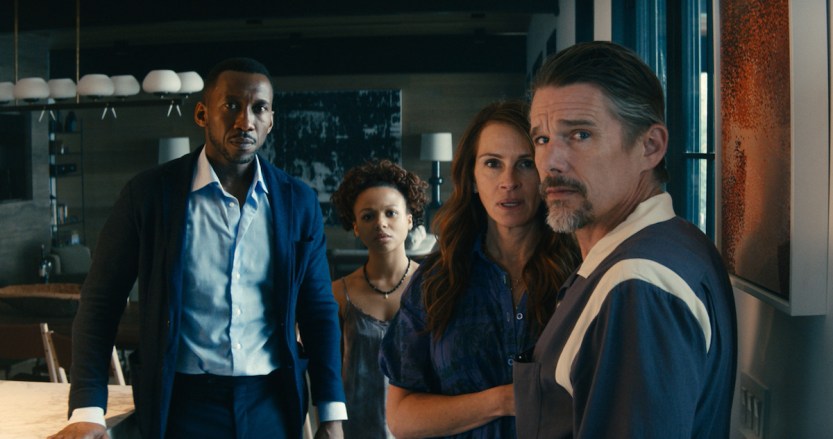
Spoiler alert: If you have not watched the Netflix original movie “Leave the World Behind,” you should watch it before reading further.
The Christmas holidays are great for a number of reasons, but key among them for me is that I get to at least approach catching up on all of the movies and shows that don’t make time to watch during the regularly scheduled work season. Some friends recommended “Leave the World Behind” on Netflix, but also mentioned that they found it kind of deep and the end was not exactly straightforward. For that reason, it got bumped down my list a bit. Today it rose to the top.
I actually did find the ending quite straightforward, but I also found the journey to get there captivating. I very much enjoy studying human behavior (as you know if you read this space regularly) and this film is a wonderful opportunity to do just that. Here are a few examples of what I mean:
Julia Roberts
To the extent that the film has one main character, that would be the one played by Julia Roberts (Amanda). Right from the start we find her to be neurotic, perhaps a little on the ADHD side, and she tells us that she really doesn’t like people. She is distrustful, unfriendly and at times downright rude to others. Ironically, we learn that she basically in sales, getting to know people so she can sell them things they don’t need (in her words). In other words she can turn on the charm and warm up to people when money is on the line, but it has made her cynical and cold.
When Mahershala Ali’s character (G.H.) shows up with his daughter, we see both of Amanda’s extremes. She is aggressively unfriendly, perhaps even with racist undertones, when they first show up. As the story progresses we see her forced to confront her inner demons, eventually befriending G.H.’s daughter and very nearly having a romantic encounter with G.H. one stormy night as they dance to old school vinyl.
For me the takeaway from Amanda’s character arc is that once people are removed from the pressure and stress of daily life, they tend to relate to others more effectively. Even in a time of crisis, basic human nature starts to emerge and she finds that she has more in common with G.H. than she would have guessed at first. People, after all, are people, and most people are good down at the core. I guess that makes her the Ebenezer Scrooge of this story, since it’s Christmas time.
Ethan Hawke
Ethan Hawke’s character, Clay, is the ultimate peacemaker, which he would have to be in order to survive being married to Amanda. I guess that would make him representative of most men I know, who have to work really hard and sacrifice to navigate the turbulence of marriage. He wants to accommodate everyone, help everyone get along, and he can’t really relax and just be himself unless he’s drunk or high. We see this in a scene where G.H.’s teenage daughter Ruth gets him to smoke dope and he starts to unload. She later suggests to her father that Clay wants to have sex with her, but she was clearly the one trying to instigate such an encounter (which doesn’t actually come to pass). Through it all, Clay is the peacemaker and appeaser, and I found that character to be incredibly familiar.
Mahershala Ali
One of the reasons I wanted to see this film is because I have very much enjoyed Ali’s work, especially in “Green Book.” His role in this movie is quite different, as he brings a mysterious element to the proceedings. He knows something important, it’s really obvious that what he knows makes him nervous and uncomfortable, and until we find out what it is he is a central point of tension in the story. He also embodies what is surely one of the big themes the producers wanted to get across. Namely, there was rich and powerful people who know a lot more about what’s going on in the world than anyone else living in it. They are behind much of the global conflict we see in the news and they make sure the big issues facing our world go unaddressed. It’s all about money for them…and yeah…duh. We seem to worship money, and money is like a sickness that robs people of their consciences and even common sense as they ruthlessly pursuit the acquisition of more. This will be our undoing, and that’s exactly what’s playing out at the end of the movie.
Kevin Bacon
That weird guy you know who hoards bottled water and canned food, always preparing for the imminent end of the world, just sure “they” are coming for us…that’s Kevin Bacon’s “Danny.” Danny isn’t surprised by what’s happening, is pretty sure something similar happened in Cuba recently and his basic instinct is to protect what’s his at all costs. He is neighbors and friends with G.H., but once disaster strikes he answers the door with a shotgun and basically tells G.H. “sorry about your bad luck.” This is where Clay shines as a peacemaker. Clay’s son needs medication, Danny has the medication, but he nearly shoots G.H. rather than offer up that medication. Clay’s emotional appeal cools the situation and Danny does, eventually, provide the medication.
As something of a side note, Danny mentions that they have a rich and even more paranoid neighbor who built an expansive bomb shelter under his house. This becomes critical at the end of the film, but not for the reason he would seem to be foreshadowing.
Farrah Mackenzie
The character who really struck me in this story is Amanda and Clay’s teenage daughter, Rosie. She is extremely distressed throughout the film because when the internet goes out she was just about to watch the final episode of the sitcom “Friends,” and she didn’t know know it ended. This becomes an endless refrain for her, as everything else is going wrong, she just stay fixated on the ending, which turns out to be extremely relevant to the final message of the movie.
Before we get to that, there is another point made in the middle of the show that struck home with me. When asked why she was so worried about some old TV show, Rosie answers simply that watching it makes her happy. This resonated with me because even at a time when I have thousands of movies and TV shows at my fingertips, I often find it comforting to just sit back and watch “Cheers,” “Star Trek” or “Perry Mason” because, at the end of the day, they make me happy. It’s like slipping into a favorite pair of jeans or pajamas. There’s something comfortable about those familiar worlds with those familiar characters.
As for Rosie, she’s the one who wanders off and discovers the well-appointed bomb shelter at the rich neighbor’s house. Down there she discovers a vast media collection, including, of course, the entire “Friends” series. She euphorically puts in the final disc of the final season and presses play as the movie’s end credits roll.
So the entire country is destroying itself, her mother is distraught because she’s missing, but as long as she has junk food and “Friends” life is good.
There’s something to be said about this final point, because in many ways we, as a society, are that little girl, happily eating junk food and watching TV while our world is torn apart by global political powers, climate change and the bullshit scandal of the day (cancel culture menu, please). On the one hand, it does feel overwhelming when I think about the miniscule power of one person to really change the big things we need to change. On the other hand, it’s frustrating that people don’t seem willing to do the absolute minimum things we can do to help (like vote responsibly).
At the end of the day, “Leave the World Behind” gave me something to think and write about. It’s definitely worth watching and contemplating.
Enjoy and Happy New Year!
(Have you seen it? Leave your thoughts in the comments section below and let’s discuss!)
-B
 Ishmael's Legacy