To be fair, two hours ago I had never heard of Jeffrey Lamar Williams, nor had I heard his pseudonym, “Young Thug.” Apparently he’s a rap artist, and rap has deviated so far from the form that I enjoyed in the 80s and 90s (Run DMC, The Beastie Boys, Fresh Prince, etc) that I can’t even listen to it any more. That’s fine. I have nothing against “Young Thug” and his like, I just choose not to tune in.
Well, it turns out he might just be worthy of some of my attention. No, I’m not tuning in to Spotify to catch his top hits, but I do think his current case being heard before a federal court in Fulton County, Georgia could have wide ranging implications.
Yes, Fulton County is where former President Donald Trump is facing one of many federal indictments, and the case of this young rapper is extremely relevant to that proceeding. Not only is Williams being prosecuted by the same district attorney in the same court as Trump, he’s also facing essentially the same charge. This brings us to what I believe will be the singularly most important issue on the table in 2024.
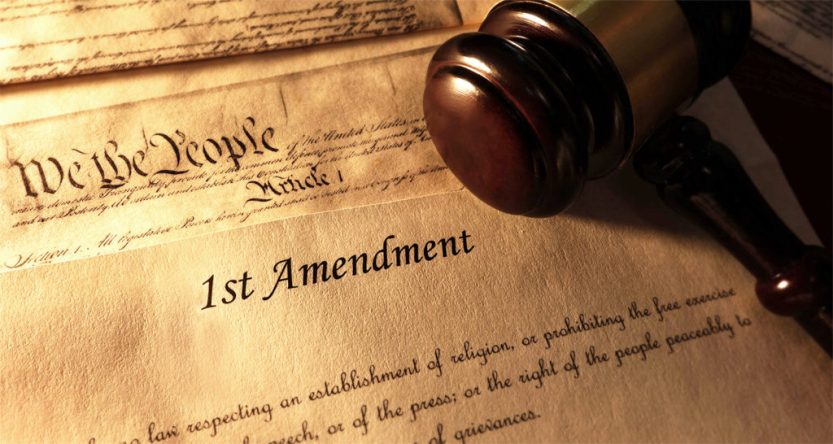
Is stochastic terrorism “protected speech” under the First Amendment of the US Constitution?
This month, the judge presiding over the Williams trial made the controversial decision to allow prosecutors to use some “Young Thug” song lyrics, including, “I never killed anybody, but I got something to do with that body,” as evidence that Williams directed his alleged gang to commit murder and other felonies. Does Williams, then, bear some responsibility for the acts of violence committed at his musical instigation? Is suggesting such a thing a violation of Williams’ freedom of speech as protected by the First Amendment?
More importantly, does any of this sound familiar?
After Donald Trump took to social media to spur his minions into action on January 6, 2020, does he bear some of the responsibility for the ensuing riot at the US Capitol?
I do have my opinions about both cases, but I’m not here to debate the finer points of a document written over 200 years ago by men who could not possibly imagine how that document would be tested in 2024. They could never have conceived of guns that fire hundreds of rounds a second being used to murder school children and they could never imagine someone in the role of the venerable George Washington using his influence to attempt a coup d’état. That being said, they also didn’t imagine that we would still be looking at the same, unchanged document all these years later, trying to apply ancient understandings to modern issues.
Thomas Jefferson famously wrote that we should “provide in our constitution for its revision at stated periods.” “[E]ach generation” should have the “solemn opportunity” to update the constitution “every nineteen or twenty years,” thus allowing it to “be handed on, with periodical repairs, from generation to generation, to the end of time.”
I have often thought about the wisdom behind Jefferson’s words, and have equally wondered why we have never done what he admonished us to do. The Constitution is essentially in crisis, a crisis that ripples out across our entire political and legal landscape. Not unlike our other revered historical documents and treatises, we need to put modern eyes on ancient contexts and arrive at an updated (repaired) Constitution to help preserve the longest-tenured democracy in existence… lest we lose it as Jefferson no doubt foresaw.
-B
 Ishmael's Legacy